The Seiko 5126-6010 is an unusual watch for a number of reasons. To begin with it’s a Japanese domestic market model which means exactly what it says, it was designed and produced for the Japanese domestic market! Seiko had some much funkier designs for their home market than they did for the rest of the world and this model featured is no exception with its cushion case, orange dial and inner rotating ring. The orange versions of these models remind me of Doxas Sharkhunter, probably no coincidence considering the original orange dialed Sharkhunter was introduced in the 1960’s and Seikos 5126-6010’s date from the late 1960’s. Another unusual feature of this watch is the calibre 5126 movement. It’s an automatic winding, 23 jewel, 19,800bph movement with a day date complication. These weren’t produced for very long and consequently you don’t see them very often these days. The movement architecture is quite a departure from what Seiko was utilising in their other calibres, notably there’s no pawl and transmission wheel autowind components, and the keyless work looks quite different too. This calibre has more in common with the Swiss method of using reverser wheels to convert the rotors movement into winding the mainspring. As you can see from the picture below this model was part of their “Sports” range, watches that were part of that range had their water resistance upped to 70m depth. Interestingly this model was also given the “5” designation. “Seiko 5” has these days become a symbol of their lower range value for money watches but when the “5” designation was introduced in the 1960’s it was a symbol of Seikos rugged, dependable and unique watches which was meant to represent 5 different selling points, automatic winding, day and date displayed in a single window, water resistance, a recessed crown at the 4 o’clock position and a durable case and bracelet. It’s nice to see that this example still has it’s original signed “Razor” bracelet that’s sized for a European wrist.
Seiko

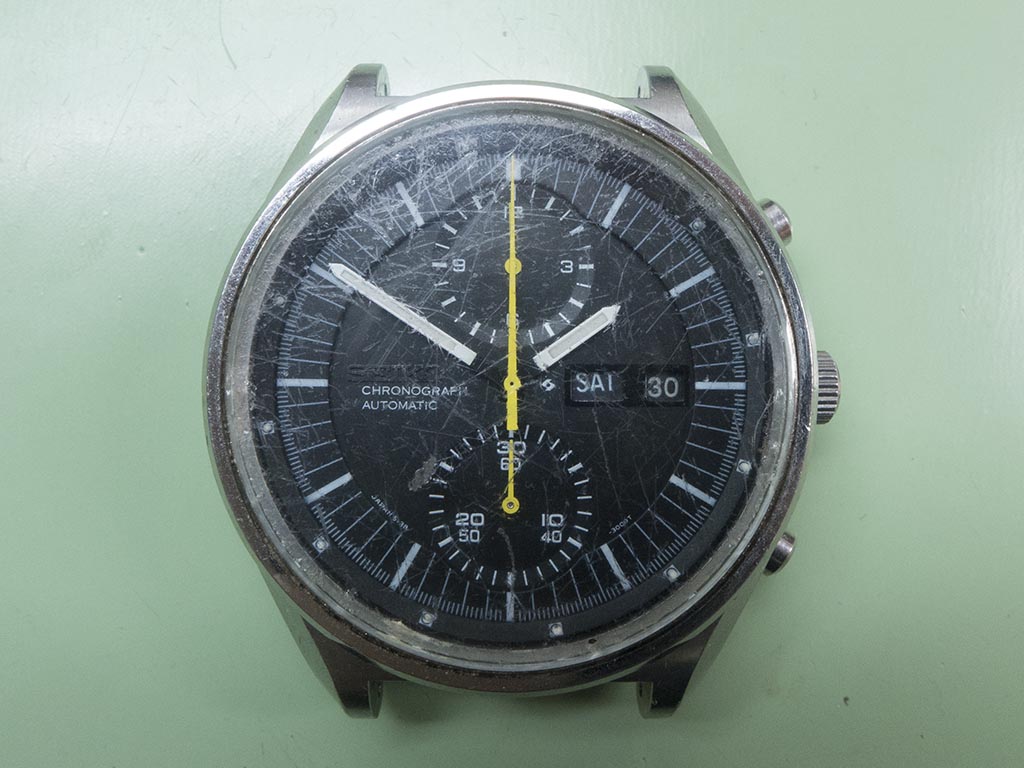
Seiko 6138-3002 chronograph
Seiko is well known for getting their 6139 chronograph to market in February 1969, the first automatic chronograph available to the public at that time. The story goes they wanted to release the twin register 6138 first, but because of the extra layer of components for the hour recording wheel it’s a more complicated watch than the single register 6139 and it wasn’t moving forward as fast as they’d like. Consequently they focused their energy on getting the 6139 to market to try and beat the two other contenders who were also developing automatic chronographs, namely Zenith-Movado group and a joint effort from Breitling, Hamilton/Bren, Heuer/Leonidas and Dubois-Dpraz. The arguments are still being done to death as to who actually was the first to market but my take is Seiko takes that accolade, your views may differ! This 6138-3002 came in for a full movement service as it wasn’t running correctly and a new crystal.
Seiko 6206-8040 Business
During the 1960’s a lot of different Seiko models carried the “Business” or “Business A” logo. This branding appealed to Seikos marketing department for a short period and seemed to be aimed at the Japanese salary man. He could proudly wear his new Seiko to work knowing it was designed for “business” people! The example featured is powered by the calibre 6206B, an automatic wind, 18,000bph, 26 jewel day/date movement. As I’ve mentioned before the 62xx series powered a vast range of Seikos models from divers to Grand Seikos. This one came in for a service and to sort out the common problem of the crown jumping whilst setting the day, date or time. As can be seen these models are a handsome watch which wear a lot bigger than they actually are due to the slim bezel making the dial look huge. A feature I particularly like about these is the full day window, these were typically positioned at 6 or 9 0’clock on the dial. The sunburst finish of the dial is also a nice touch.

Seiko 6217-8000
And yet another 62mas is featured today, but not any old 62mas – this is a rather special one. I picked up the watch a while ago and it has been sitting in the project drawer for some time now whilst I a) decided what to do with it, and b) actually arranged my schedule so I could get on with it. As you can see the watch wasn’t in too bad a condition when it arrived, it was minus an insert but complete. A yobokies insert was purchased and that was fitted before this shot was taken.

Seiko 6217-8001
Another 6217-8001 is featured today, I can’t resist them! This example was purchased new in 1966 by the current owners father who was then a seafaring man and a bit of a character by all accounts.

Seiko 6306 Scubapro 450
The Scubapro 450 is based on Seikos 6306-7001 model, and were produced in the late 1970’s as part of a marketing contract in conjunction with the Scuba-pro dive equipment company. The model it’s based on is a Japanese domestic market watch produced alongside the very similar 6309-7040. The difference between the calibre 6306 and 6309 is the 6306 has a kanji day wheel, has four extra jewels, it has a hacking mechanism and has different machining around the crown making the opening slightly larger. The difference between the Scubapro 450 and a stock 6306 is just the printing on the dial. The most obvious difference is the “Scubapro 450” script situated above the “Water 150 Resist” on the dial, but a harder to see change is the dial code went from 700L T to 700J T. It’s generally accepted that the Scubapro versions were produced between 1978 and 1979 but to muddy the waters examples have surfaced with caseback dates of 1976, 77, and 83. Were these actually produced in those years or have the casebacks been changed? The 1983 example is doubly strange because that one post dates 6306’s end of production date of 1981! As ever with vintage Seiko nothing is clear cut – part of the appeal maybe? The example featured below is in outstanding condition and belongs to a very knowledgeable UK collector. It came in for a full movement service so I seized the chance to document it!

Seiko 6105-8110
Every now and then I get a watch in that seems to fight me at every turn, and this particular 6105 is one of those watches! It arrived looking a little worse for wear, the lume was starting to degrade on the dial and the handset was well advanced with the rot. It had an aftermarket insert fitted but didn’t actually look to bad at first sight.

Seiko 6217-8001
Regular readers will know the 62 series calibres are my favourite vintage Seiko movements, you’ll also know the 62mas is my favourite vintage Seiko divers watch. Another one has been across the bench today so here’s a peek at what I had to contend with. The watch arrived to me after having a relume so the hands are in the little container. As you can see it’s a little scruffy with its scratched crystal but it has the basis of a good honest watch.

Seiko Black Bay mod
Something I’m asked to do occasionally is to modify a watch or “mod” it as this is known. The donor watches are usually Seikos as there is a huge amount of custom parts available for many different models. The watch featured here is a Seiko SXK009 and the parts to be fitted will turn it into a Tudor Black Bay homage. The parts needed to accomplish this are a snowflake handset, a dial, an insert, a polished rehaut or chapter ring and a sapphire crystal was also fitted although not strictly necessary.

Seiko World Time
Seikos reference 6217-7000 World Time was introduced in 1964 to coincide with the Olympic games which were held in Tokyo that year. Seiko were chosen as the official timekeepers for the event, a very prestigious contract to be awarded. The watch was powered by the automatic, 17 jewel, 18,000bph, 6217a calibre which was actually a development of the 603 calibre which first appeared in 1960. The 62xx series of movements powered everything from the World Time to the Grand Seikos of the day. The World Time allows you to determine the time in any one of 24 time zones around the globe with the use of its rotatable inner bezel. Line up a city that’s in your current timezone with the 24 hour hand and you can reference the other timezones using the 24 hour scale. This example came in for a movement service and a bit of work to the bracelet. It’s unusual in a couple of respects, firstly it has the more uncommon brown dial and city ring (these were mostly produced with a sliver dial and city ring), and secondly it’s still on its original bracelet which you very rarely see. It always a pleasure to work on a watch which means a lot to the owner, this was his late fathers watch who bought it brand new back in the sixties.

 The Watch Bloke